Executive Summary
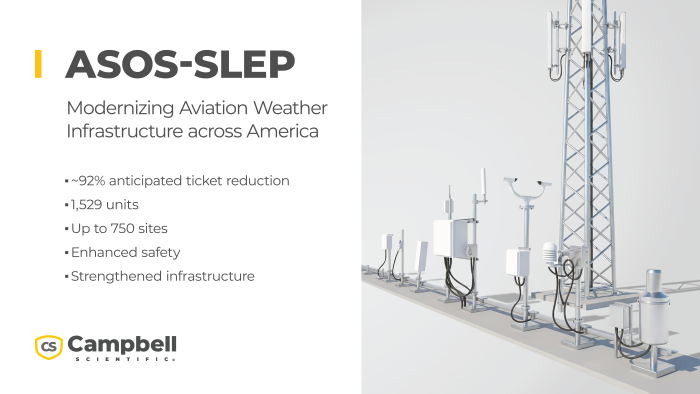
Campbell Scientific partnered with the National Oceanic and Atmospheric Administration’s National Weather Service (NOAA-NWS), the Federal Aviation Administration (FAA), and the US Department of Defense (DoD) to deliver 700 acquisition control units (ACU), 799 data collection packages (DCP), and 50 single cabinet automated surface observation systems (ASOS) (SCA) for the ASOS modernization efforts across the United States.
Through the ASOS Surface Life Extension Program (SLEP), Campbell Scientific engineered and delivered ASOS 2.0, a next-generation International Civil Aviation Organization (ICAO), World Meteorological Organization (WMO), and FAA-compliant system designed to reduce maintenance costs, eliminate parts obsolescence, and improve data reliability. This nationwide modernization strengthens aviation safety, enhances real-time weather reporting, and ensures long-term serviceability for one of the country’s major sources of aviation and surface weather data.
Key Outcomes
At a glance, the following are noteworthy project outcomes:
- 91.7% expected reduction in monthly maintenance tickets
- 1,529 units delivered for use at up to 750 sites, including:
- 700 ACUs
- 799 DCPs
- 50 SCAs
- 1,529 units delivered for use at up to 750 sites, including:
- Improved system reliability and data continuity
- Future-proofed components that eliminate parts obsolescence
- Enhanced aviation safety with more accurate weather reporting
- Strengthened federal weather infrastructure across NOAA-NWS, FAA, and DoD sites
Background: The Role of ASOS in U.S. Aviation and Weather Monitoring
The ASOS network was originally developed by NOAA-NWS, the FAA, and the DoD to provide real-time surface weather observations for aviation, weather, and climate monitoring at hundreds of airports across the United States. The nationwide network, designed in the early 1980s and deployed throughout the 1990s, has supported millions of flights and decades of weather and climate records.
Why it matters
The ASOS network is engineered to impact lives by providing actionable data at airports of all sizes, from small, local airports to major regional hubs. The network provides continuous, real-time weather data to aviators, weather analysts, policy makers, climatologists, and other professionals, ultimately enabling them to make informed, confident decisions when safety and efficiency are on the line.
The Challenge: Aging ASOS Infrastructure and Rising Maintenance Demands
After decades of operation, the federal weather infrastructure began to experience increasing failures and rising maintenance costs. Perhaps most impactfully, more than 80% of the components in the original ASOS units had become obsolete. The tri-agencies observed that system reliability declined sharply, and maintenance demands grew to unsustainable levels.
On average, 6,000 maintenance tickets were submitted for the aging ASOS stations with peak periods reaching more than 8,000 tickets per month.
Why it matters
Routine repairs quickly became costly, time-consuming, and increasingly disruptive to aviation operations. When the ASOS aviation weather stations required maintenance, pilots and air traffic controllers were left without the critical data needed to guide aircraft safely to the ground. The absence of reliable wind data often forced planes to circle airports for long periods, wasting fuel and increasing operational strain. System failures also contributed to delayed flights and temporary groundings, as well as gaps in the nation’s weather and climate records, necessitating gap-filling.
These issues underscored the broad operational and economic impact of an aging ASOS network.
The Solution: Campbell Scientific’s ASOS 2.0 Modernization
In 2019, the tri-agencies selected Campbell Scientific to modernize the nation’s infrastructure via an ASOS-SLEP contract. Through this initiative, Campbell Scientific developed the next generation of ASOS technology, referred to as ASOS 2.0, and provided 1,529 units including:
- 700 ACUs
- 799 DCPs
- 50 SCAs
These units could be deployed at up to 750 sites, primarily U.S. airports, to enhance data quality and system reliability.
To prevent the parts obsolescence challenges that affected earlier stations, the upgraded ASOS 2.0 design incorporates fully future-proofed components that can easily be replaced as needed. This modular approach allows agencies to replace individual parts, significantly lowering long-term maintenance demands and reducing overall costs.
Why it matters
ASOS 2.0 strengthens the nation’s aviation and weather reporting infrastructure by delivering more reliable data and reducing system downtime. With future-proofed, modular components, agencies can keep stations operating smoothly without expensive overhauls. The advancement supports safer, more efficient flight operations, and a resilient system that enables critical weather and climate decision-making.
Results: Improved Reliability, Reduced Maintenance, and Stronger Reporting
By 2025, Campbell Scientific had delivered all 1,529 units to NOAA-NWS, the FAA, and the DoD, marking a major step forward in modernizing the United States’ airport weather monitoring infrastructure. The tri-agencies now expect maintenance tickets to drop to fewer than 500 per month after the upgraded systems are fully deployed, which is a projected reduction of 91.7%.
At the time of this writing, the agencies are conducting their final acceptance testing. After the installation and commissioning are complete, the upgraded ASOS network will deliver stronger data continuity, greater system reliability, significantly reduced maintenance costs, and improved long-term serviceability. Reducing the risk of flight delays, the new system will deliver improved weather data to tower operations, improving flight management at airports across the United States. These enhancements will ensure that pilots, forecasters, air traffic controllers, climatologists, and other professionals have consistent access to accurate and timely weather information.
Why it matters
The successful delivery of ASOS 2.0 represents a major leap forward for national aviation efficiency and weather observation accuracy. After deployment, maintenance tickets are expected to drop by more than 90%, allowing agencies to redirect resources from constant repairs to higher-value mission needs. Having more reliable airport weather monitoring stations means more consistent data for pilots, air traffic controllers, and meteorologists, which reduces delays, improves forecasting, and strengthens decision-making across the aviation and weather enterprise.
ASOS 2.0 ensures that the nation’s critical weather infrastructure remains dependable, cost-effective, and ready to support the evolving demands of modern air traffic and weather and climate monitoring.
This case study will be updated following deployment.
Connect with Campbell Scientific to explore next steps for developing or modernizing your weather observation infrastructure.
Case Study Summary
Application
Surface life extension for aviation weather ASOS stationsLocation
Up to 750 sites across the United StatesProducts Used
AeroX Audio 105 SDM-SIO2R CR1000XParticipating Organisations
National Oceanic and Atmospheric Administration National Weather Service (NOAA-NWS), Federal Aviation Administration (FAA), Department of Defense (DoD)Related Website
NOAA-NWS: Welcome to ASOSView the PDF