Overview
The Kameng Hydroelectric Power Project (KaHPS) sits deep in the Himalayan foothills of Arunachal Pradesh, one of India’s most ecologically sensitive and infrastructure-critical regions. At its core are two dam structures, Bichom and Tenga, together generating 600 MW of hydroelectric power in northeastern India.
Dam safety in this environment is not a routine matter. Steep terrain, high seepage zones, monsoon-driven weather extremes, and remote access all compound the risk. North Eastern Electric Power Corporation Limited (NEEPCO) needed more than periodic inspections. They needed a system that could monitor both dams continuously, translate raw sensor data into actionable intelligence, and signal problems before they escalate.
Campbell Scientific India, working with the KaHPS authorities, designed and deployed an integrated geotechnical and environmental monitoring system across both sites. The result is a unified, real-time view of structural health and environmental conditions, built to operate reliably in one of the country’s most demanding dam environments.
From periodic inspections to continuous intelligence, this automated system monitors both dams around the clock, ready to flag anomalies the moment they emerge.
What Was Built
The deployment covered both dam sites end-to-end, from sensor selection and installation to system integration, operator training, and handover. Every component was selected for the Himalayan operating environment: temperature swings, humidity, vibration, and the logistical constraints of gallery-based work inside active dam infrastructure.
The instrumentation suite included:
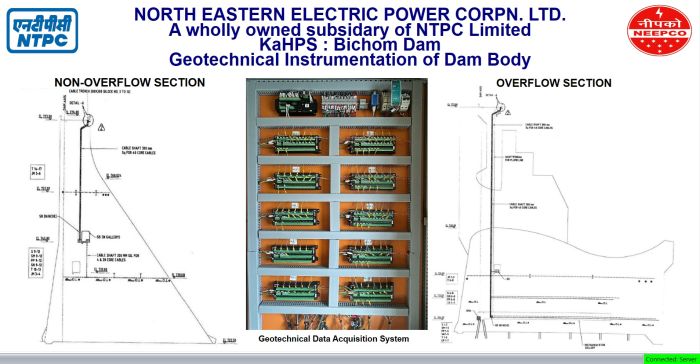
- Vibrating wire sensors measuring uplift pressure and joint behavior within dam galleries
- V-notch seepage monitoring systems installed at critical gallery drain points
- Plumb line assemblies tracking structural displacement over time
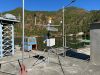
- Automated weather stations (AWS) on dam-top locations capturing site-specific meteorological data
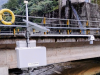
- Automatic water level recorders (AWLR) monitoring reservoir and sump conditions
CR6 High-Capacity Data Acquisition Systems, paired with multiplexers, formed the data acquisition backbone. A wired communications network tied field instruments to centralized control rooms at each site. Real-Time Monitoring and Control (RTMC) software brought the data together into a single monitoring interface, with configurable alarms and real-time visualization for operators.
Challenges and How They Were Solved
Remote hydroelectric projects in hilly terrain come with a predictable set of complications. On this project, several arrived at once.
Access constraints inside operating dam galleries limited where civil works could happen and how equipment could be staged. The team worked around this by optimizing installations using existing structures and custom mounting solutions, avoiding the need for new civil works where possible.
Sensor anomalies emerged during commissioning, particularly with V-notch and vibrating wire readings. Campbell Scientific’s VWAnalyzer was used to systematically diagnose each issue. Where sensors had drifted from calibration, they were recalibrated in the field before the system went live.
Electrical grounding within the gallery environment was inconsistent, which created instability in the data stream. The team worked directly with site engineers to establish proper earthing across both dam locations, resolving the issue at its source rather than compensating for it in software.
Software configuration and CR6 programming required real-time collaboration between field engineers and technical support throughout commissioning. The complexity of integrating new instrumentation with existing site infrastructure demanded a hands-on, adaptive approach rather than a scripted rollout.
Every technical obstacle on this project had a root cause. The team found it, fixed it, and documented the resolution for the operators who would run the system long after commissioning was complete.
System Architecture
The monitoring architecture was designed for two priorities: reliability and scalability. Both dams run independently but feed into a common data framework, making it possible to compare conditions across sites and expand the system in the future without redesigning the core infrastructure.
Sensors installed across galleries, dam tops, and reservoir interfaces feed into CR6 systems integrated with AM16/32B multiplexers. The multiplexers allow high-density channel acquisition from the vibrating wire network without requiring a dedicated data logger per sensor cluster. A wired backbone carries data from each field location to the control room servers at both dams.
On the visualization side, RTMC software provides operators with a real-time dashboard covering all measured parameters. Alarms can be configured at threshold levels for any variable, giving the team early warning before a reading becomes a risk. The server-side architecture was installed on-site to keep the system operational even during connectivity interruptions.
The backbone of the system is LoggerNet software, which provides a wide range of advanced data management and monitoring capabilities. One of its key features is the automatic periodic archival of data from multiple data loggers deployed across the dam monitoring network. This ensures secure data storage, seamless data retrieval, and efficient long-term records management, making it a valuable feature implemented across these dam monitoring projects.
Results and Benefits
The system now provides NEEPCO with continuous visibility into dam performance across both Bichom and Tenga, under all operational and environmental conditions. Key outcomes include:
- Real-time monitoring of uplift pressure, seepage, crack/joint movement, dam tilt using automatic plumb line, and weather across both dam sites
- Early anomaly detection, enabling proactive maintenance before issues reach critical thresholds
- Reduced dependence on manual inspection cycles, with automated data collection replacing many routine site visits
- Improved data accuracy through calibrated instrumentation and a validated earthing infrastructure
- A centralized RTMC interface, giving operators a single view of system health across both dams
Longer term, the architecture positions KaHPS for expansion. New sensors or monitoring parameters can be integrated into the existing network. The data history being built now will support trend analysis and predictive maintenance as the infrastructure matures.
Conclusion
Dam safety is not a problem you solve once. Dam structures such as Bichom and Tenga change over years and decades, shaped by seasonal cycles, seismic activity, and cumulative operational load. A monitoring system that captures that change in real time, and alerts engineers when something shifts outside expected parameters, is the foundation of responsible infrastructure management.
The KaHPS deployment demonstrates what that foundation looks like in practice: instrumentation chosen for the environment, architecture designed for reliability, and a commissioning process rigorous enough to resolve every technical issue before handover. NEEPCO now has the tools to manage both dams with confidence, informed by data rather than inference.
For organizations managing critical water infrastructure in challenging terrain, this project is a demonstration that rigorous monitoring is achievable, and that the data it produces changes how decisions get made.